
Project overview
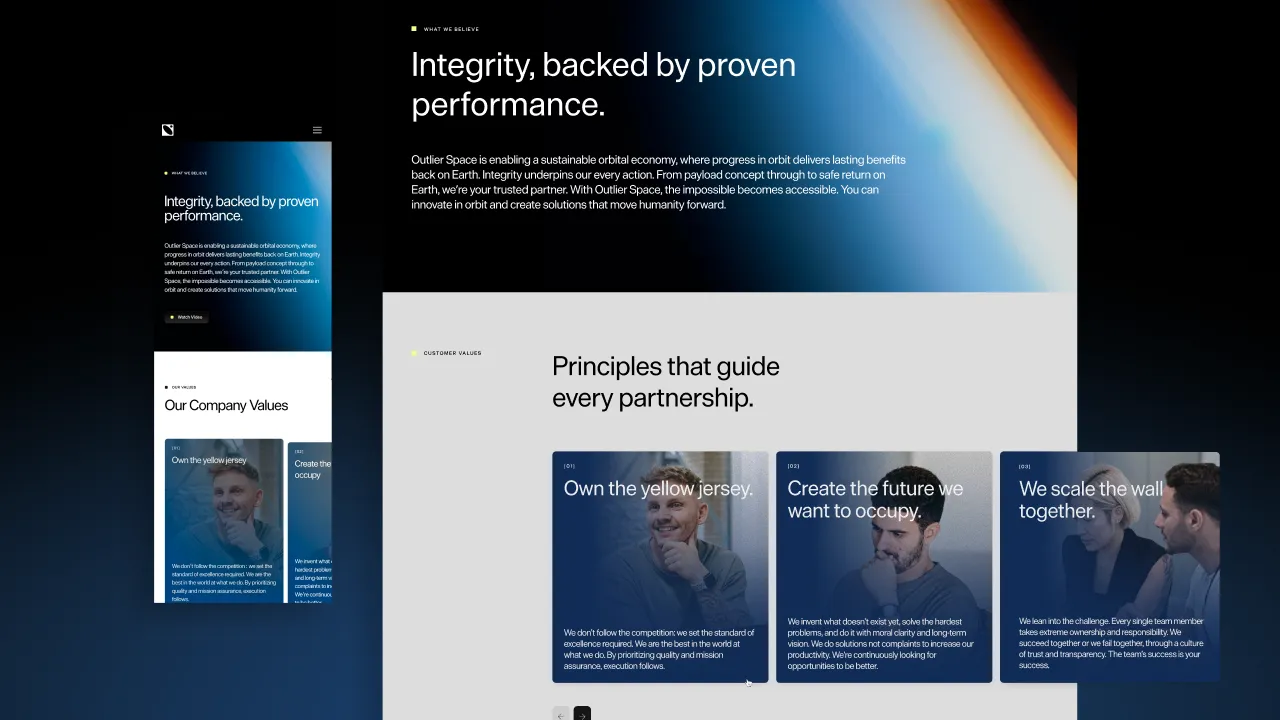
Outlier Space came to us with the mission of making microgravity accessible, scalable, and reliable.
In late July the company announced a US$7.35m pre-seed round led by Global from Day One, with Airtree, Icehouse Ventures, Investible, Nova Threshold and Side Stage Ventures alongside. One of the largest pre-seed rounds New Zealand has seen.
Outlier is building is a reusable, rocket-agnostic capsule that carries a payload into orbit, holds it in microgravity for weeks or months, then brings it back down intact. It will be New Zealand's first reentry vehicle, with room on board comparable to three ISS mid-deck lockers. Worth spelling out why anyone wants that, because most people's mental model of space is launch and comms. On Earth, molecules in a solution separate by weight and convection moves everything around. Take gravity away and they stay evenly distributed, so crystals grow far more uniform in size and structure than anything achievable on the ground. Pharmaceutical companies want this. So do biotech and advanced materials manufacturers. The ISS has been the only reliable way to get it, and the ISS is scheduled to come down after 2030.
Jamie France founded the company in 2024, after sixteen years designing for Emirates Team New Zealand's America's Cup campaigns and most of a decade at Rocket Lab, leaving as global director of Electron production.
Three groups of people were going to arrive and want completely different things. Researchers in pharma and biotech want to know how clean the microgravity is and whether the payload survives the trip home. Manufacturers care about cadence and payload volume, and whether the apparatus they build can scale across missions instead of being rebuilt each time. Government buyers are thinking about sovereign capability, and about reaching orbit without standing up a spacecraft programme of their own.
We built one spine with three branches off it. The spine is the platform and what it physically does. The branches swap vocabulary entirely, so a researcher reads about convection and sedimentation where a government buyer reads about capability and risk transfer. All three end at the same contact form, routed to the nearest regional office, answered inside 24 hours. Aerospace procurement moves in quarters, so putting a response time in writing does more work than it looks like it should.
Throughout the site our goal was to create micro moments of joy and interaction through the implementation of microgravity. We wanted users to feel as if they were experiencing the effects of microgravity themselves. When you hover a card, it suspends in space. Flick the switch in the footer, and words fall to the floor.